
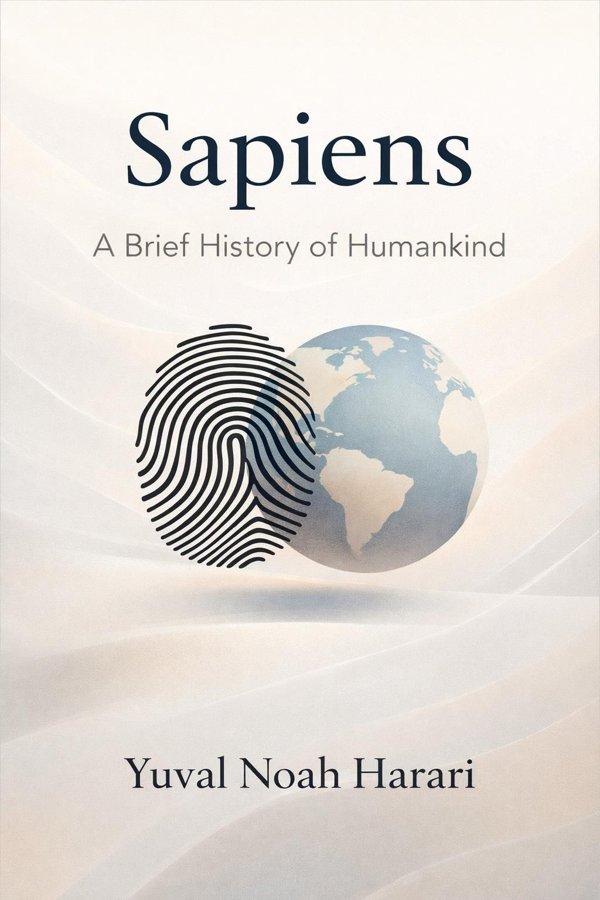
Sapiens: Summary & Key Insights
 10 min2 chaptersAudio available
About This Book
Sapiens: A Brief History of Humankind is a historical essay that explores the evolution of the human species from the earliest Homo sapiens to the modern era. Yuval Noah Harari examines how biology, anthropology, and economics have shaped human societies, highlighting three major revolutions: the cognitive, the agricultural, and the scientific. The book offers a panoramic view of how ideas, myths, and social structures have enabled humans to dominate the planet.
Sapiens: A Brief History of Humankind
Sapiens: A Brief History of Humankind is a historical essay that explores the evolution of the human species from the earliest Homo sapiens to the modern era. Yuval Noah Harari examines how biology, anthropology, and economics have shaped human societies, highlighting three major revolutions: the cognitive, the agricultural, and the scientific. The book offers a panoramic view of how ideas, myths, and social structures have enabled humans to dominate the planet.
Who Should Read Sapiens?
This book is perfect for anyone interested in history and looking to gain actionable insights in a short read. Whether you're a student, professional, or lifelong learner, the key ideas from Sapiens by Yuval Noah Harari will help you think differently.
- ✓Readers who enjoy history and want practical takeaways
- ✓Professionals looking to apply new ideas to their work and life
- ✓Anyone who wants the core insights of Sapiens in just 10 minutes
Want the full summary?
Get instant access to this book summary and 500K+ more with Fizz Moment.
Get Free SummaryAvailable on App Store • Free to download
Key Chapters
About seventy thousand years ago, something extraordinary happened. Our ancestors, who had lived much like other animals, began to imagine things that did not exist. They developed the ability to think abstractly, to communicate through complex language, and to create shared myths. This Cognitive Revolution was not a sudden biological mutation but a transformation in information processing—a turning point where thought became collective.
Through language, humans invented reality itself. We learned to tell stories about spirits, tribal ancestors, and gods. These stories created trust among strangers, allowing us to cooperate in groups that far exceeded the size of typical primate communities. This capacity for fiction became the secret of our success. A chimpanzee can warn its companions of danger, but it cannot persuade fifty others to follow a common vision. A human can rally thousands under the banner of an invisible deity or an imagined flag.
I often think of this moment as the dawn of culture. From it stemmed everything—religion, law, art, and science—all built upon the same foundation of shared meaning. Once we began to believe in imagined realities, the possibilities expanded infinitely. The Cognitive Revolution thus marked the beginning of history as we know it. It turned mere survival into storytelling, transforming Homo sapiens from animals of instinct into creatures of narrative and belief.
Around ten thousand years ago, humans began to cultivate crops and domesticate animals, converting from nomadic foragers into sedentary farmers. At first glance, this seems like progress—a triumph of human ingenuity. Yet, as I argue, this revolution was not so much a blessing as a trap. Foraging societies were relatively healthy, diverse, and mobile; the new agricultural ones became bound to the land, exposed to disease, and dependent on monotonous diets.
The paradox of the Agricultural Revolution lies in its collective success but individual suffering. Wheat and rice multiplied, towns grew, and populations soared—but the average farmer’s life became harder than that of a hunter-gatherer. In chasing security, humans surrendered freedom, bending their backs to the rhythms of field and harvest. It was not humanity that domesticated wheat—it was wheat that domesticated humanity.
Still, agriculture enabled the emergence of social hierarchies, cities, and eventually civilizations. Surplus created storage; storage created property; property created inequality. The great monuments of history—the pyramids, temples, and palaces—were built upon this new order of labor and control. To understand our modern economy, one must recognize this origin: progress often requires some to serve, many to sacrifice, and a few to prosper.
All Chapters in Sapiens
About the Author
Yuval Noah Harari is an Israeli historian and professor at the Hebrew University of Jerusalem. He is known for his works on global history and philosophy, including Sapiens, Homo Deus, and 21 Lessons for the 21st Century. His work combines history, science, and philosophical reflection to analyze the past and future of humanity.
Get This Summary in Your Preferred Format
Read or listen to the Sapiens summary by Yuval Noah Harari anytime, anywhere. FizzRead offers multiple formats so you can learn on your terms — all free.
Available formats: App · Audio · PDF · EPUB — All included free with FizzRead
Download Sapiens PDF and EPUB Summary
Key Quotes from Sapiens
“About seventy thousand years ago, something extraordinary happened.”
“Around ten thousand years ago, humans began to cultivate crops and domesticate animals, converting from nomadic foragers into sedentary farmers.”
Frequently Asked Questions about Sapiens
Sapiens: A Brief History of Humankind is a historical essay that explores the evolution of the human species from the earliest Homo sapiens to the modern era. Yuval Noah Harari examines how biology, anthropology, and economics have shaped human societies, highlighting three major revolutions: the cognitive, the agricultural, and the scientific. The book offers a panoramic view of how ideas, myths, and social structures have enabled humans to dominate the planet.
Compare Sapiens




More by Yuval Noah Harari

You Might Also Like


Featured In
Bill Gates's Book Picks
Bill Gates' Reading List: The Books That Shaped a Visionary
Mark Zuckerberg's Book Picks
Mark Zuckerberg's Year of Books: His Top Picks
Naval Ravikant's Book Picks
Naval Ravikant on Wealth and Wisdom: Essential Reads
Tim Ferriss's Book Picks
Tim Ferriss's Toolkit: Books for Peak Performance
Barack Obama's Book Picks
Barack Obama's Reading List: Books That Shaped a President
Joe Rogan's Book Picks
Joe Rogan's Go-To Books: What He Can't Stop Recommending
Richard Branson's Book Picks
Richard Branson's Lifetime Reading List: Adventure in Every Page
James Clear's Book Picks
James Clear's Reading List: Books That Build Better Habits
Malcolm Gladwell's Book Picks
Malcolm Gladwell's Picks: Books That Make You See the World Differently
Sam Altman's Book Picks
Sam Altman's Reading List: Books Behind the AI Revolution
Trevor Noah's Book Picks
Trevor Noah's Thought-Provoking Reads
Neil deGrasse Tyson's Book Picks
Neil deGrasse Tyson's Science Bookshelf
Yuval Noah Harari's Book Picks
Yuval Noah Harari's History & Future Reading
Morgan Housel's Book Picks
Morgan Housel's Financial Wisdom Reads
Psychology's Book Picks
Inside Your Mind: Psychology Books That Change Everything
Ready to read Sapiens?
Get the full summary and 500K+ more books with Fizz Moment.