
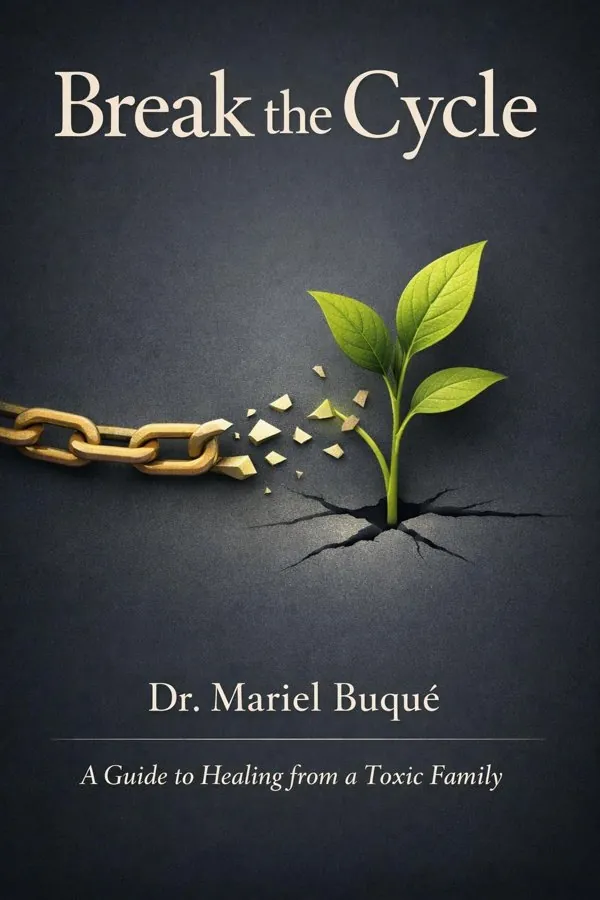
Break the Cycle: A Guide to Healing from a Toxic Family: Summary & Key Insights
 10 min6 chaptersAudio available
About This Book
In this groundbreaking work, Dr. Mariel Buqué, a clinical psychologist and intergenerational trauma expert, explores how family trauma is passed down through generations and offers practical tools to stop the cycle. Drawing on psychology, neuroscience, and cultural wisdom, she guides readers through the process of identifying inherited pain, healing emotional wounds, and building healthier relationships.
Break the Cycle: A Guide to Healing from a Toxic Family
In this groundbreaking work, Dr. Mariel Buqué, a clinical psychologist and intergenerational trauma expert, explores how family trauma is passed down through generations and offers practical tools to stop the cycle. Drawing on psychology, neuroscience, and cultural wisdom, she guides readers through the process of identifying inherited pain, healing emotional wounds, and building healthier relationships.
Who Should Read Break the Cycle: A Guide to Healing from a Toxic Family?
This book is perfect for anyone interested in mental_health and looking to gain actionable insights in a short read. Whether you're a student, professional, or lifelong learner, the key ideas from Break the Cycle: A Guide to Healing from a Toxic Family by Dr. Mariel Buqué will help you think differently.
- ✓Readers who enjoy mental_health and want practical takeaways
- ✓Professionals looking to apply new ideas to their work and life
- ✓Anyone who wants the core insights of Break the Cycle: A Guide to Healing from a Toxic Family in just 10 minutes
Want the full summary?
Get instant access to this book summary and 500K+ more with Fizz Moment.
Get Free SummaryAvailable on App Store • Free to download
Key Chapters
To truly comprehend what it means to inherit emotional pain, we must first define intergenerational trauma. It is not a vague concept; it is the measurable imprint of experiences passed down through families, often unconsciously. When an ancestor endures a profound trauma—loss, abuse, displacement, systemic oppression—that event does not remain contained in their lifetime. It leaves neurobiological signatures that can alter how their descendants react to stress or perceive safety.
I often tell my clients that trauma becomes a family language, transmitted through behaviors, silence, and emotional reactivity. You may have grown up in a household where anger felt explosive, where affection was paired with fear, or where love was conditional. Those patterns are not random; they’re forms of protection inherited from those who had to survive. The problem arises when survival patterns persist long after the danger is gone.
Psychology and neuroscience reveal how such patterns are encoded. Chronic stress changes brain structures like the amygdala and prefrontal cortex, heightening vigilance. Epigenetics shows that trauma can modify gene expression, making the stress response more likely to trigger. When you feel irrational fear in a perfectly safe setting or find yourself repeating relationship cycles that cause harm, you are often experiencing echoes of this inherited wiring.
What’s essential is awareness. When you begin to name the emotions, behaviors, and family stories that repeatedly reappear, you start shifting from reaction to response. The process of breaking the cycle begins with seeing your pain not as weakness but as information—a coded message that, once deciphered, guides you toward healing.
Family systems operate much like emotional ecosystems. Each member influences and is influenced by the others. Many of the behaviors that seem deeply personal—our perfectionism, our guilt, our need to control—are actually systemic responses to collective wounds. By examining this web, we can uncover how trauma becomes normalized within families.
In therapy, I often encourage drawing what I call a trauma genogram, a family tree that doesn’t just record names and dates but maps emotional patterns, losses, and relational fractures. As you do this, certain trends may appear: generations of parental abandonment, hidden griefs, or the repetition of similar relationship failures. Such mapping brings clarity to invisible legacies.
The key to approaching this exercise is compassion. You are not doing this to assign blame but to witness truth. Seeing our parents or grandparents through the lens of their own survival can create empathy without excusing harm. When we recognize that anger was their armor, silence their shield, we stop internalizing their pain as our fault. We begin reclaiming agency over what belongs to us and gently returning what never did.
+ 4 more chapters — available in the FizzRead app
All Chapters in Break the Cycle: A Guide to Healing from a Toxic Family
About the Author
Dr. Mariel Buqué is a Dominican-American psychologist, intergenerational trauma expert, and sound bath meditation healer. She is known for her work on holistic mental health and cultural healing practices, and her insights have been featured in major media outlets such as The New York Times and Vogue.
Get This Summary in Your Preferred Format
Read or listen to the Break the Cycle: A Guide to Healing from a Toxic Family summary by Dr. Mariel Buqué anytime, anywhere. FizzRead offers multiple formats so you can learn on your terms — all free.
Available formats: App · Audio · PDF · EPUB — All included free with FizzRead
Download Break the Cycle: A Guide to Healing from a Toxic Family PDF and EPUB Summary
Key Quotes from Break the Cycle: A Guide to Healing from a Toxic Family
“To truly comprehend what it means to inherit emotional pain, we must first define intergenerational trauma.”
“Family systems operate much like emotional ecosystems.”
Frequently Asked Questions about Break the Cycle: A Guide to Healing from a Toxic Family
In this groundbreaking work, Dr. Mariel Buqué, a clinical psychologist and intergenerational trauma expert, explores how family trauma is passed down through generations and offers practical tools to stop the cycle. Drawing on psychology, neuroscience, and cultural wisdom, she guides readers through the process of identifying inherited pain, healing emotional wounds, and building healthier relationships.
You Might Also Like
Big Feelings: How to Be Okay When Things Are Not Okay
Liz Fosslien, Mollie West Duffy
10 min
Creative Arts Therapies Handbook: Art, Music and Dance Therapy Practices for Wellbeing
Susan I. Buchalter
10 min
Emotional First Aid: Healing Rejection, Guilt, Failure, and Other Everyday Hurts
Guy Winch
10 min
Lost Connections: Why You're Depressed and How to Find Hope
Johann Hari
10 min
No Time to Panic: How to Stop Worrying and Embrace Life
Matt Gutman
10 min
Overcoming Mobbing: A Recovery Guide for Workplace Aggression and Bullying
Maureen Duffy, Len Sperry
10 minFeatured In
Ready to read Break the Cycle: A Guide to Healing from a Toxic Family?
Get the full summary and 500K+ more books with Fizz Moment.